A practitioner-level guide to navigating Malaysia's multilingual media market, from regulatory compliance to channel strategy.
Plan your Malaysia advertising strategy with confidence
Read this guide before briefing any campaign in Malaysia - it covers every channel, regulation, and cultural consideration that shapes how advertising works here.
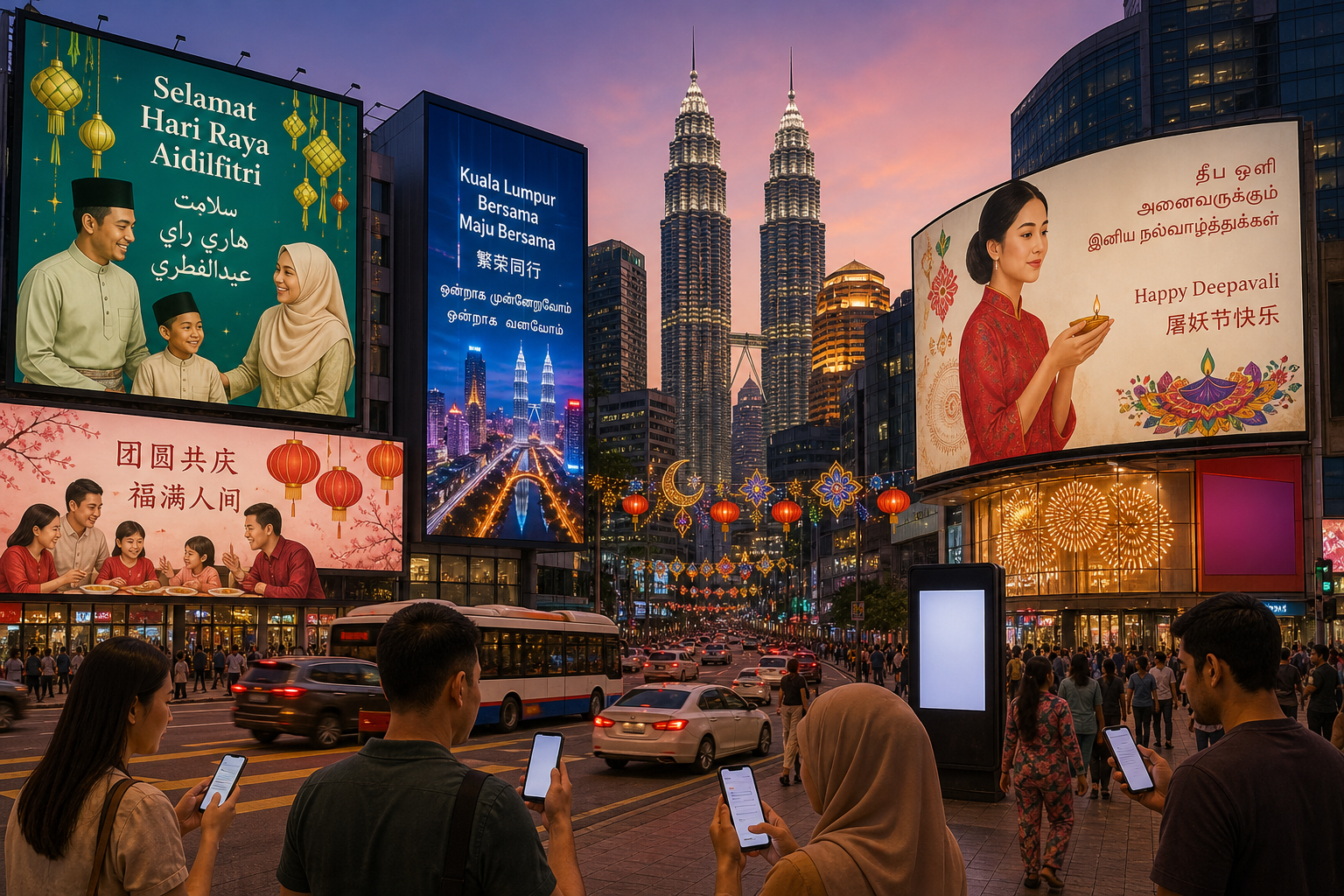
Malaysia's audience is not one market but four
Malay, Chinese, Indian, and English-speaking communities each bring distinct media habits, cultural reference points, and language preferences. A campaign that resonates with Malay-majority audiences in Kedah may land very differently among Mandarin-speaking consumers in Penang or Tamil-speaking households in Johor. This is not a minor planning nuance - it shapes everything from channel selection to creative messaging to the timing of a campaign around festivals. Hari Raya, Chinese New Year, Deepavali, and Christmas all carry commercial weight, but each demands its own tone, imagery, and media mix. Brands that treat Malaysia as a single homogeneous market consistently underperform against those that plan for its genuine plurality. The multilingual dimension also has regulatory implications: privacy notices for targeted advertising must, for instance, be issued in both Malay and English under the Personal Data Protection Act 2010.
The main advertising channels and how they are used
Television remains a significant reach vehicle, particularly for Malay-language audiences via national broadcasters, and carries its own advertising and censorship codes. Digital has grown rapidly, driven by internet penetration that reached 97.7% of Malaysia's population in January 2025, with active audiences on Facebook, Instagram, TikTok, and YouTube. Out-of-home advertising, including billboards and digital OOH screens along highways and in urban centres, falls under the jurisdiction of state and local authorities rather than a single national body, so compliance requirements vary by location. Print retains relevance for certain demographic segments and for category-specific advertising. Most effective campaigns in Malaysia run across several of these channels simultaneously, with digital typically serving as the performance layer and TV or OOH providing mass reach and brand salience.
Regulatory bodies and the rules every advertiser must know
Malaysia's advertising governance is a mix of statute and self-regulation, with no single advertising law covering the entire industry. The key instruments are the Trade Descriptions Act 2011, the Consumer Protection Act 1999, the Communications and Multimedia Content Code, the Personal Data Protection Act 2010, and the Malaysian Code of Advertising Practice. The Advertising Standards Authority of Malaysia (ASA), established in 1977, administers the Advertising Code for print. Online and broadcast content falls under the Communications and Multimedia Content Code, registered with the MCMC. The Medicine Advertisement Board approves all advertising for medicines, treatments, and diagnostics. The Malaysian Code of Advertising Practice requires all ads to be legal, decent, honest, and truthful, and prohibits content that is misleading through inaccuracy, exaggeration, ambiguity, or omission. Advertisements must not be offensive to standards of decency, and must be sensitive to religion and ethnicity.
Cultural and religious considerations that affect creative decisions
Islamic advertising standards are not optional for brands operating in Malaysia. Content that could be construed as disrespectful to Islam, or that promotes products conflicting with Islamic values, faces regulatory and reputational risk. This extends to imagery, music choices, and the portrayal of gender and family. Halal certification and religiously appropriate messaging are often prerequisites, not differentiators, for reaching the Malay-Muslim majority. Beyond Islam, Chinese and Indian cultural sensitivities around colour symbolism, auspicious dates, and community values also shape how creative is received. Professionals such as doctors and dentists are prohibited from endorsing medical products. Certain product categories - alcohol, tobacco, pharmaceuticals, slimming products, and others - face specific restrictions or outright prohibitions on advertising. Bait advertising is explicitly not allowed under the Malaysian Code of Advertising Practice.
Digital advertising compliance and what is changing in 2025
The digital advertising environment in Malaysia is evolving quickly at both the market and regulatory level. MCMC's class licensing regime for large social media and messaging platforms took effect at the start of 2025, adding a new compliance layer for advertisers running campaigns through those platforms. Targeted advertising using personal data requires the explicit consent of data subjects, and privacy notices must be issued in both Malay and English. The Communications and Multimedia Act 1998 prohibits content that is indecent, obscene, false, menacing, or offensive in character. From 1 June 2026, under-16s cannot hold their own social media accounts, which will affect how brands target younger audiences. The Content Code 2022 defines a child as under 18 and a young child as under 12, with stricter standards applying to advertising directed at these groups. Staying current with these changes is not a one-time exercise - the regulatory environment is actively shifting.
Main advertising channels in Malaysia
Malaysia's diversity is the biggest opportunity and the most demanding planning challenge in Southeast Asian advertising.
Advertising in Malaysia: scenarios from the market
FMCG brand running a multilingual digital campaign
A fast-moving consumer goods brand launching a new product nationally needs to reach Malay, Chinese, and Indian consumers without a single creative execution doing all the work. The media plan splits budget across language-specific digital placements - Malay-language content on national platforms, Mandarin content on platforms with high Chinese-Malaysian usage, and Tamil content targeted to relevant regions. Each execution is reviewed for cultural and religious appropriateness before going live. Consent-based data targeting requires privacy notices in both Malay and English, adding a compliance step to the digital setup. The result is a campaign that reads as locally relevant to each community rather than generically Malaysian.
Retail brand using OOH and social for a festive push
A retail chain planning a Chinese New Year campaign combines highway billboard placements in high-traffic urban corridors with a social media campaign on Facebook and Instagram timed to the pre-festival shopping window. OOH site selection requires approval from the relevant state or local authority, so lead times are longer than for digital placements. The social campaign uses short-form video creative optimised for mobile viewing, reflecting Malaysia's high smartphone penetration. Creative decisions - colour palette, family imagery, auspicious messaging - are made with the specific cultural context of the Chinese New Year audience in mind, not adapted from a generic regional template.
Multinational brand entering the Malaysian market
A multinational brand entering Malaysia for the first time faces a compliance audit before any creative goes live. Advertising governance spans multiple bodies - the ASA for print, the MCMC and Communications and Multimedia Content Code for digital and broadcast, state authorities for OOH, and the Medicine Advertisement Board if any health claims are involved. The brand's global campaign assets require localisation not just in language but in cultural tone, and any health or efficacy claims must meet the standards of the Malaysian Code of Advertising Practice, which prohibits misleading statements by inaccuracy, exaggeration, or omission. A local media partner with established relationships across these regulatory bodies significantly reduces the time needed to get campaigns approved and live.
Advertising in Malaysia: questions marketers ask
Is there a legal requirement to advertise in Bahasa Malaysia?
There is no blanket legal requirement for all advertising to be in Bahasa Malaysia, but certain contexts carry specific language obligations. Privacy notices for targeted digital advertising must be issued in both Malay and English under the Personal Data Protection Act 2010. National broadcasters and government-linked media have their own language policies, and brands targeting the Malay-majority audience will find Bahasa Malaysia essential for effective reach regardless of legal minimums.
What rules apply to advertising during Ramadan or around Islamic occasions?
The Malaysian Code of Advertising Practice requires that advertisements not be offensive to standards of decency and must be sensitive to religion and ethnicity. Content that could be construed as disrespectful to Islam, or that promotes products conflicting with Islamic values, faces both regulatory and reputational risk. During Ramadan in particular, brands are expected to exercise heightened sensitivity in imagery, music, and messaging. There is no single Ramadan-specific advertising code, but the general content standards enforced by the ASA and MCMC apply throughout the year.
How does digital advertising regulation work in Malaysia?
Digital advertising in Malaysia is governed primarily by the Communications and Multimedia Content Code, registered with the MCMC, and the Communications and Multimedia Act 1998, which prohibits indecent, obscene, false, menacing, or offensive content. MCMC's class licensing regime for large social media and messaging platforms took effect at the start of 2025, adding new compliance obligations for advertisers using those platforms. Targeted advertising using personal data also requires consent and a bilingual privacy notice under the Personal Data Protection Act 2010.
Which product categories face the strictest advertising restrictions?
Several categories are subject to specific rules or outright restrictions. Medicines, treatments, and diagnostics require pre-approval from the Medicine Advertisement Board before any advertising can run. Alcohol and tobacco advertising is heavily restricted. Slimming products, cosmetics, pesticides, food and drinks, and sanitary pads each have their own sector-specific rules. Bait advertising is prohibited across all categories under the Malaysian Code of Advertising Practice, and professionals such as doctors and dentists cannot endorse medical products.
How should a brand choose between digital and traditional media channels in Malaysia?
The choice depends on the audience, the campaign objective, and the product category. Malaysia's internet penetration reached 97.7% in January 2025, making digital a near-universal reach vehicle, but television still delivers scale and credibility for Malay-language audiences, and OOH provides strong brand salience in high-traffic urban and highway locations. Most effective campaigns use a combination: digital for targeting precision and performance measurement, TV or OOH for reach and brand-building. A media planning partner with current data on audience behaviour across channels is the most reliable guide to the right mix for a specific brief.
What should a brand know about advertising to children and young people in Malaysia?
The Content Code 2022 defines a child as under 18 and a young child as under 12, with stricter advertising standards applying to content directed at these groups. From 1 June 2026, under-16s will not be permitted to hold their own social media accounts, which will materially affect how brands reach younger audiences through social platforms. Brands advertising products aimed at children should review both the Content Code and the Malaysian Code of Advertising Practice, which requires that advertising not exploit the trust or lack of knowledge of consumers, a standard applied with particular care to younger audiences.
Benefits
Local market fluency, applied daily
MCC's team brings senior experience from international networks, combined with deep knowledge of Malaysia's multilingual audience segments, festive calendar, and media owner landscape. This local fluency shapes every planning decision, from channel mix to cultural tone, in ways that a regional or global agency operating at arm's length cannot replicate.
Global network access via Hakuhodo
Through its affiliation with Hakuhodo, Japan's second-largest advertising agency, MCC connects clients to a global network of offices and capabilities. This gives Malaysian brands international reach and regional brands entering Malaysia a locally embedded partner with global-standard planning discipline.
Media owner relationships that matter
MCC's long-standing relationships with all major media partners in Malaysia, backed by significant media billings, allow the agency to negotiate customised deals across TV, digital, OOH, and print. Established relationships with media owners translate into better access, flexibility, and measurable ROI for clients, particularly in a market where relationships and local knowledge carry real weight.
Consumer insight methodology that de-risks campaigns
MCC's approach blends research data with experiential intuition to understand audiences from multiple perspectives, a methodology that is particularly valuable in Malaysia's multicultural market. Consumer segmentation work helps brands avoid the common mistake of treating Malaysia as a single audience, and instead plan campaigns that speak meaningfully to distinct communities.
Ready to advertise in Malaysia with a partner who knows the market
MCC has been planning and buying media across Malaysia's multilingual market since 2007, with the local relationships, regulatory knowledge, and consumer insight methodology to help brands navigate it effectively. If you are planning a campaign in Malaysia and want a partner who understands the market from the inside, talk to the MCC team.